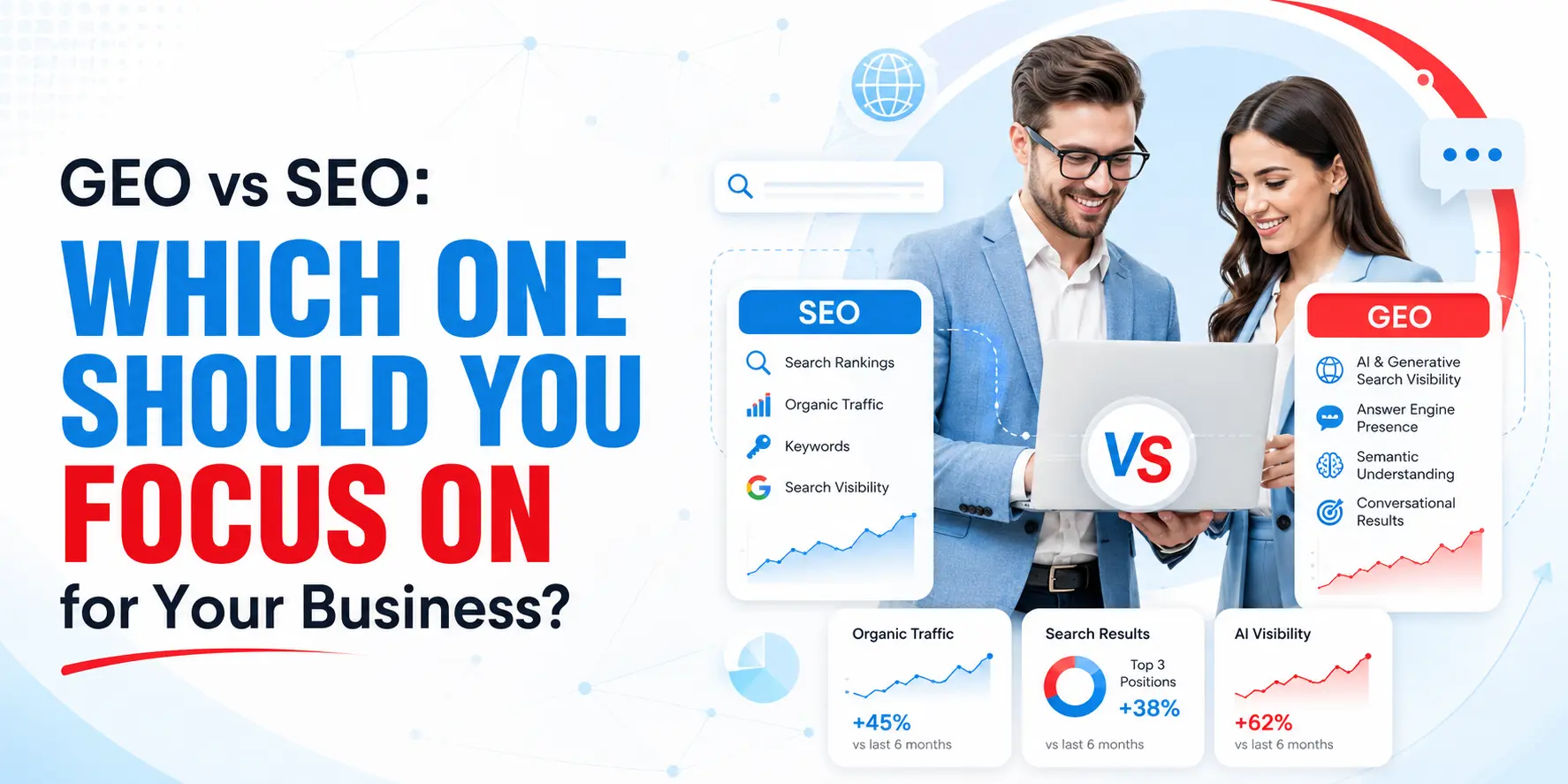
The argument between GEO and SEO has become one of the most popular subjects among marketers and business owners in today’s rapidly evolving digital landscape. The way people find information is changing quickly due to the emergence of generative engines and AI-powered search tools like ChatGPT, Gemini, and Perplexity.
The key question, however, is whether you should concentrate on conventional SEO or switch to the more recent trend of Generative Engine Optimization (GEO).
We’ll dissect both ideas, point out the main distinctions, and assist you in selecting the one that best suits your company’s objectives in this blog.
SEO, or Search Engine Optimization, is the process of optimizing your website to rank higher on traditional search engines like Google and Bing. It’s how your customers find you when they type keywords related to your business.
For years, SEO has been the foundation of online visibility, driving organic traffic, leads, and conversions. It’s measurable, proven, and essential for building long-term digital presence.
Generative Engine Optimization (GEO) is the latest evolution of digital visibility, focusing on optimizing content for AI-driven search platforms rather than traditional search engines.
Unlike SEO, where users see a list of ranked links, GEO ensures your content is featured within AI-generated answers. Think of it as getting mentioned by ChatGPT or Gemini when someone asks a question related to your niche.
As generative search becomes more common, GEO helps businesses stay visible when users stop “Googling” and start “asking AI.”
Let’s compare the two approaches and see where they differ most:
| Aspect | SEO | GEO |
| Focus | Optimizing for Google, Bing, and other search engines | Optimizing for AI-powered search and assistants |
| Goal | Ranking high in search results | Being featured or cited within AI-generated answers |
| Content Style | Keyword-driven, structured for ranking | Entity-driven, structured for AI comprehension |
| Metrics | Clicks, impressions, traffic | Mentions, citations, AI visibility |
| User Behavior | Users click through to websites | Users often get instant answers (zero-click) |
| Tools | Google Analytics, Ahrefs, SEMrush | AI monitoring tools, structured data tracking |
While SEO helps people find your website, GEO ensures your content is found even if they don’t click a link, both are crucial for maintaining relevance in 2025 and beyond.
Choosing between GEO and SEO isn’t an either/or decision, it’s about understanding how they complement each other.
For businesses like those at NJ Marketing, this means continuing your strong SEO strategies while integrating GEO techniques to reach emerging audiences.
Many marketers jump on trends too fast. Avoid these pitfalls when balancing GEO and SEO:
Failing to track performance, measure both SEO rankings and AI presence to gauge progress.
In the evolving world of digital marketing, the debate of GEO vs SEO isn’t about competition, it’s about evolution. SEO remains the bedrock of online visibility, while GEO represents the next frontier of AI-driven discovery.
At NJ Marketing, we believe the future belongs to businesses that adapt early. Whether you’re starting your SEO journey or preparing for GEO dominance, the right mix of both will keep you ahead of the competition.
Stay visible. Stay relevant. Stay optimized, for search and for AI.
NJ Marketing is a full-service digital agency based in Mississauga, Ontario. We blend data-driven marketing, strategic web development, and custom branding solutions to help businesses scale.



Copyright © 2026 All Rights Reserved. Developed by njsoftlab.
